Buy Pancragen Online for Research | COA Guide
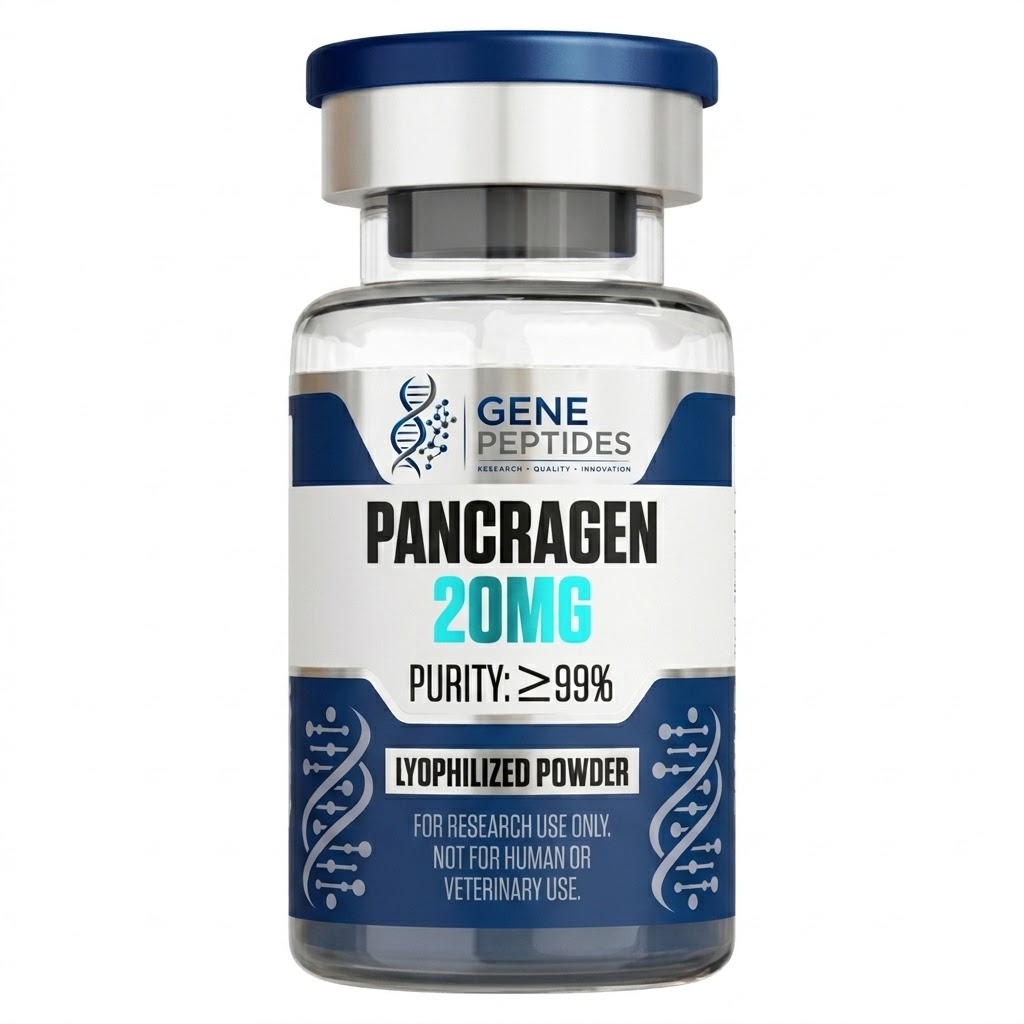
Researchers searching for buy Pancragen online should evaluate Pancragen as a research-use-only laboratory material, not a consumer product. For laboratory buyers, key considerations include compound identity, Pancragen COA access, purity documentation, batch-specific traceability, product labeling, and storage information. This guide explains how qualified research teams can evaluate Pancragen research material for controlled research procurement through Pure Lab Peptides while separating supplier documentation from published scientific context.
Fast Answer: buy Pancragen online for laboratory research
Researchers can buy Pancragen online for laboratory research by reviewing RUO labeling, batch-specific COA documentation, purity data, identity information, storage guidance, and supplier transparency before selecting a source. Products discussed in this article are intended for laboratory research use only and are not intended for human or animal consumption.
What Does “Buy Pancragen Online” Mean in a Research Context?
The phrase “buy Pancragen online” is addressed here as laboratory research procurement intent, not personal-use intent. In this context, the search query refers to how qualified researchers, laboratory buyers, research institutions, and technical procurement teams evaluate a Pancragen research-use-only material before adding it to a controlled laboratory purchasing workflow.
Research procurement is documentation-driven. A laboratory buyer should confirm RUO labeling, review the batch-specific certificate of analysis, evaluate Pancragen purity documentation, compare the product name and lot number across records, and confirm that supplier language avoids therapeutic, diagnostic, consumer, veterinary, or personal-use positioning. FDA guidance on research-use-only labeling is written for in vitro diagnostic products, but it illustrates an important general principle: RUO language separates research materials from products promoted for clinical or diagnostic use [1].
For Pancragen supplier documentation, researchers should prioritize verifiable records over promotional wording. The most useful procurement signals include batch-specific COA availability, lot-level traceability, analytical method disclosure, identity testing, storage and handling information, product-form consistency, and transparent research-use-only labeling.
Pancragen Research Material Overview
Pancragen is commonly described in research literature as the tetrapeptide KEDW, corresponding to the amino acid sequence Lys-Glu-Asp-Trp. PubChem identifies the compound H-Lys-Glu-Asp-Trp-OH with formula C26H36N6O9 and molecular weight of approximately 576.6 g/mol [2]. Standard peptide nomenclature uses amino acid abbreviations such as Lys for lysine, Glu for glutamic acid, Asp for aspartic acid, and Trp for tryptophan [3].
Because Pancragen is a short peptide, it fits the short peptide or bioregulator research category for editorial and compliance purposes. That category allows neutral discussion of peptide sequence, molecular weight, compound identity, analytical characterization, COA review, and laboratory procurement. It does not support organ-support, therapeutic, clinical, anti-aging, regeneration, disease, wellness, or human-use claims for an RUO material.
Published literature has examined Pancragen in research models and in broader short-peptide discussions. For example, Pancragen appears in experimental literature using the KEDW sequence, and broader reviews discuss short peptides as a class of chemically defined molecules with sequence-dependent characterization needs [4] [5]. These publications are useful for scientific context and compound identification, but they do not replace Pancragen identity testing, lot-specific COA review, or supplier documentation.
Short peptide research literature should be discussed as scientific context, not as product-use guidance. A Pancragen research-use-only listing should therefore focus on what can be verified: name, sequence, formula, molecular weight, product form, purity claim, analytical method, lot number, and storage documentation.
Why Researchers Search “Buy Pancragen Online”
Researchers usually search “buy Pancragen online” to compare RUO availability, product documentation, and supplier transparency. A qualified laboratory buyer is not looking for consumer advice. The procurement task is to determine whether the listed Pancragen research material is documented clearly enough for controlled laboratory intake and recordkeeping.
The secondary query buy Pancragen should be interpreted the same way. It should lead to documentation review, not use instructions. Researchers may compare product pages for RUO labeling, batch-specific COA access, product-form description, stated purity, Pancragen identity testing, storage information, and consistency between the product page and COA. They may also evaluate whether supplier pages avoid dosing, preparation, administration, therapeutic, diagnostic, veterinary, or personal-use language.
Analytical transparency matters because short peptides can require multiple forms of evidence for procurement review. High-performance liquid chromatography is widely used for peptide analysis and purification, while mass spectrometry and LC-MS methods are commonly used to support peptide identity and impurity assessment [6] [7] [8].
Research Procurement Checklist for Pancragen
- Verify that Pancragen is labeled for research use only.
- Review the batch-specific Pancragen COA before procurement.
- Confirm that the COA includes identity and purity documentation.
- Check whether HPLC, LC-MS, mass spectrometry, or another analytical method is listed.
- Compare the product name, lot number, and documentation for consistency.
- Assess whether the supplier avoids dosing, therapeutic, diagnostic, veterinary, or personal-use claims.
- Document storage and handling information in laboratory records.
- Evaluate whether lyophilized powder form matches the research workflow.
- Confirm that the product is not marketed for human or animal consumption.
- Archive Pancragen supplier documentation with procurement records for lot-level traceability.
Pancragen Quality Signals to Review Before Buying Online
When research teams type “buy Pancragen online” into a procurement search, quality review should begin with documentation rather than marketing language. The most relevant signals are RUO labeling, batch-specific COA availability, identity support, purity documentation, lot traceability, and clear product-form information.
| Evaluation Area | What Researchers Should Review | Why It Matters for RUO Procurement |
| RUO labeling | Confirm the product is clearly labeled for research use only | Helps separate research procurement from human-use positioning |
| COA availability | Review the batch-specific certificate of analysis | Supports lot-level documentation and quality review |
| Purity data | Look for analytical support for the stated purity | Helps evaluate material consistency |
| Identity testing | Review HPLC, LC-MS, mass spectrometry, or related identity data where available | Helps confirm the material matches the listed compound |
| Lot traceability | Match lot numbers across product and documentation | Supports research recordkeeping |
| Product form | Confirm whether the material is supplied as lyophilized powder or another documented form | Supports laboratory planning |
| Storage information | Review storage and handling documentation | Helps maintain material integrity in laboratory settings |
| Supplier language | Confirm the supplier avoids dosing, therapeutic, or personal-use claims | Supports research-use-only positioning |
Analytical method review should not be treated as a cosmetic step. ICH Q2(R2) and Q14 provide internationally recognized frameworks for analytical procedure validation and development, while ISO/IEC 17025 describes competence requirements for testing and calibration laboratories [9] [10] [11].
COA, Purity, and Identity Documentation
A Pancragen COA should be reviewed as a batch-specific document. Researchers should look for the compound name, lot number, test date, purity percentage, testing method, identity confirmation, molecular weight where relevant, sequence where relevant, chromatogram or mass data where available, product-form description, and storage documentation. The product page and COA should describe the same material consistently.
A purity percentage alone does not establish complete compound identity; researchers should evaluate purity, identity, method, lot number, and documentation together. This is especially important for short peptides because HPLC can support purity assessment, while mass spectrometry or LC-MS can support identity confirmation and structural verification [6] [7] [8]. Work on structurally related peptide impurities further illustrates why peptide characterization may require more than a single purity value [12].
For chromatography-based records, researchers may also compare terminology and system suitability concepts with recognized chromatography references such as USP General Chapter <621> [13]. For laboratory recordkeeping, method validation guidance can help procurement teams understand why specificity, accuracy, precision, and documented method conditions matter when reviewing analytical records [14].

Reviews
There are no reviews yet.