
Buy L-Carnitine Online for Research | RUO COA Guide
Researchers searching for buy L-Carnitine online should evaluate L-Carnitine as a research-use-only laboratory material, not a consumer product. For laboratory buyers, the key considerations are compound identity, purity documentation, batch-specific COAs, lot traceability, product labeling, and storage information. This guide explains how to evaluate L-Carnitine 200mg for controlled research procurement through Pure Lab Peptides.
Fast Answer: buy L-Carnitine online for Laboratory Research
Researchers can buy L-Carnitine online for laboratory research by reviewing RUO labeling, batch-specific COA documentation, purity data, identity information, storage guidance, and supplier transparency before selecting a source. Products discussed in this article are intended for laboratory research use only and are not intended for human or animal consumption.
What Does “Buy L-Carnitine Online” Mean in a Research Context?
The phrase buy L-Carnitine online is addressed here as laboratory research procurement intent, not personal-use intent. In this context, the search phrase relates to qualified researchers, laboratory buyers, research institutions, and technical procurement teams comparing RUO sourcing options.
A research procurement review should begin with labeling and documentation. FDA guidance for RUO and IUO in vitro diagnostic products explains that RUO labeling is connected to materials in a laboratory research phase rather than diagnostic positioning [1]. FDA labeling materials also identify the statement “For Research Use Only. Not for use in diagnostic procedures” as a prominent RUO label statement in the IVD context [2].
For procurement teams, documentation review is not limited to a product name. It includes L-Carnitine COA review, purity support, identity information, lot number matching, storage and handling notes, and supplier language. Laboratory buyers may also consider whether testing is performed by organizations aligned with recognized laboratory competence expectations. ISO/IEC 17025 describes requirements for the competence, impartiality, and consistent operation of testing and calibration laboratories [3]. Analytical documentation should also be read against method-validation principles, because ICH Q2(R2) describes how analytical procedures are evaluated for suitability through defined validation characteristics [4].
In practical procurement language, this means the buyer is asking whether the supplier can support a controlled research purchase with records that can be retained in a laboratory file. A strong file may include the supplier product page, batch-specific COA, product label image or label text, internal purchase record, receiving record, storage note, and any internal acceptance review completed by the research organization. The purpose is traceability. Each document should point to the same L-Carnitine research-use-only material and the same lot, so a later audit or internal review can understand exactly which material entered the laboratory.
Supplier language is part of the documentation review. A page that emphasizes research procurement, analytical testing, and RUO boundaries is easier to align with laboratory purchasing controls than a page that emphasizes personal outcomes. Qualified researchers should also confirm that buying language does not substitute for evidence. The ability to buy L-Carnitine online for laboratory research is only one part of the decision; the more important question is whether the supplier provides enough documentation for a technical team to evaluate identity, purity, lot traceability, and storage requirements.
L-Carnitine Research Material Overview
L-Carnitine is a small-molecule research material, not a peptide. PubChem lists the L-carnitine entry as (-)-carnitine with molecular formula C7H15NO3 and molecular weight near 161.20 g/mol [5]. HMDB identifies L-Carnitine as a quaternary ammonium compound and a metabolite detected and quantified in biological systems [6]. ChEBI lists the stereochemical entry as (R)-carnitine, and ChEMBL lists carnitine as a small molecule with the same formula and molecular weight range [7] [8]. KEGG identifies L-Carnitine as compound C00318 and records synonyms used in biochemical pathway databases [9].
Research literature commonly discusses L-Carnitine in relation to the carnitine shuttle and long-chain fatty acid beta-oxidation models. Longo, Frigeni, and Pasquali reviewed carnitine transport and fatty acid oxidation, while Bremer reviewed carnitine metabolism and functions in foundational biochemical literature [10] [11]. Hoppel and Foster also reviewed the carnitine system in metabolic research contexts, including its role in transport of activated acyl groups [12] [13]. Rebouche and Paulson summarized carnitine metabolism in human biology literature, and Ramsay reviewed carnitine-system relevance in peroxisomal fatty acid oxidation [14] [15].
This scientific context does not create product-use guidance. Metabolic pathway literature should not be translated into weight-loss, performance, or wellness claims for RUO materials. For a laboratory buyer, L-Carnitine research material should be evaluated through identity, purity, batch documentation, and traceability rather than expected outcomes.
For procurement purposes, the stereochemical and salt-form details matter. A product name such as L-Carnitine should be matched against the COA, label, and any molecular information supplied with the lot. Researchers should not assume that a database entry, a general synonym, or a common name is identical to every purchasable form. If a supplier lists a hydrochloride salt, tartrate salt, free base, hydrate, or another specific form, the COA and product page should identify that form consistently. For L-Carnitine 200mg, the material review should focus on the listed product identity and the batch-specific documentation supplied by Pure Lab Peptides.
Because L-Carnitine is not a peptide, sequence verification is not the central identity feature. Instead, a small-molecule review may emphasize molecular formula, molecular weight, stereochemical naming, chromatographic behavior, mass spectral information, and comparison to an appropriate reference standard when such information is supplied. Researchers should treat the phrase L-Carnitine research material as a procurement description. It does not imply clinical positioning, supplement positioning, or personal-use suitability.
Why Researchers Search “Buy L-Carnitine Online”
Researchers search buy L-Carnitine online to locate research-use-only product availability and compare supplier documentation. The practical goal is not to learn how to use the compound. The goal is to determine whether a supplier provides clear product identity, batch-specific COA access, L-Carnitine purity documentation, L-Carnitine identity testing, storage information, lot traceability, and consistent RUO labeling.
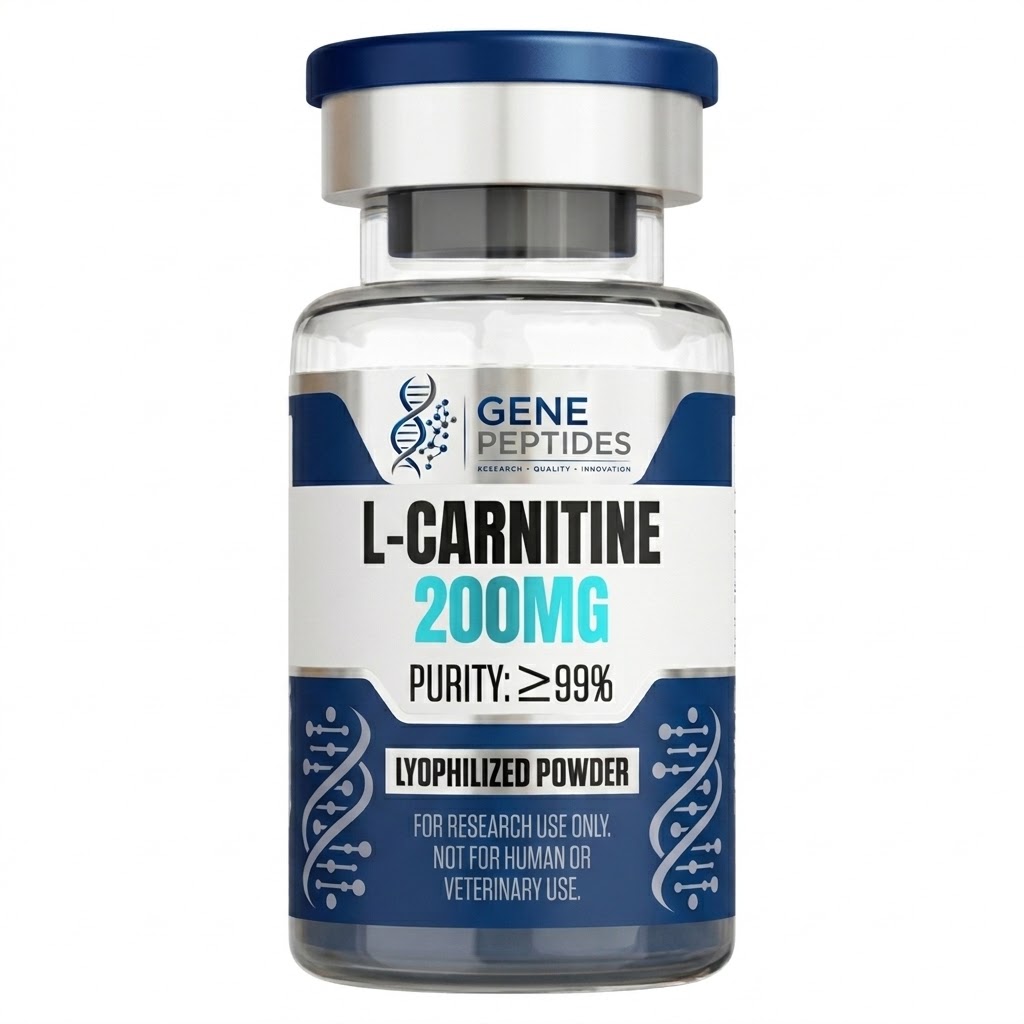
Procurement teams that need to buy L-Carnitine for controlled laboratory work should also evaluate product form. L-Carnitine 200mg from Pure Lab Peptides is presented as lyophilized powder, with a stated purity claim of ≥99% and a batch-specific COA available. Researchers should compare the product page, COA, label information, and laboratory records so the compound name, amount, lot number, and documentation remain aligned.
Search behavior also reflects workflow needs. A research institution may need a small, documented RUO material for preliminary method development, reference-comparison work, or controlled laboratory characterization. The procurement team may therefore compare several supplier pages and ask whether each one provides a coherent documentation package. A product page that lists the amount but omits COA access, lot traceability, or identity information gives the technical reviewer less to evaluate.
Another reason researchers search this phrase is supplier transparency. Transparent suppliers make the intended-use boundary easy to see, identify the product form, describe the documentation available, and avoid language that would shift the page toward consumer guidance. For L-Carnitine supplier documentation, the safest editorial focus is quality review: COA availability, purity data, identity support, product form, storage guidance, and consistent labeling.
Research Procurement Checklist for L-Carnitine
- Verify that L-Carnitine is labeled for research use only.
- Review the batch-specific certificate of analysis before procurement.
- Confirm that the COA includes identity and purity documentation and the listed testing method.
- Check whether HPLC, LC-MS, mass spectrometry, or another analytical method is listed.
- Compare the product name, lot number, and documentation for consistency.
- Assess whether the supplier avoids dosing, therapeutic, diagnostic, or human-use claims.
- Document storage and handling information in laboratory records.
- Evaluate whether the lyophilized powder form matches the needs of the research workflow.
- Confirm that the product is not marketed for human or animal consumption.
Lot traceability is especially important when multiple L-Carnitine lots are evaluated over time. The receiving record should identify the lot, the storage location, the COA reviewed, and the person or role that completed the documentation check. If a research team later compares results across experiments or analytical runs, these records help separate material variation from instrument, method, or workflow variation. Traceability also helps procurement teams avoid relying on memory, screenshots without dates, or supplier claims that are not tied to a specific batch.
L-Carnitine Quality Signals to Review Before Buying Online
When researchers search buy L-Carnitine online, the strongest quality signals are documentation signals. A supplier page should make the RUO position clear, avoid personal-use language, and give researchers a path to review the product page and batch-specific documentation.
The table below is a procurement screen, not a laboratory-use protocol. It helps technical buyers decide what documents to request or retain before approving a research material. For example, a COA availability statement is useful, but the reviewer should still confirm that the COA is batch-specific and that the product name and lot number match. Likewise, a purity claim is more meaningful when the analytical method, chromatographic output, or identity confirmation is visible in the documentation package.
Quality signals should also be evaluated negatively. If supplier copy includes personal-use framing, dosing language, clinical positioning, or outcome-driven claims, that language conflicts with a strict RUO procurement posture. Researchers should prefer documentation-centered suppliers that separate research sourcing from non-research claims. L-Carnitine identity testing and L-Carnitine purity documentation should remain the center of the purchase review.
| Evaluation Area | What Researchers Should Review | Why It Matters for RUO Procurement |
| RUO labeling | Confirm the product is clearly labeled for research use only | Helps separate research procurement from human-use positioning |
| COA availability | Review the available batch-specific certificate of analysis | Supports lot-level documentation and quality review |
| Purity data | Look for analytical support for the stated purity | Helps evaluate material consistency |
| Identity testing | Review HPLC, LC-MS, mass spectrometry, or related identity data included in the documentation | Helps confirm the material matches the listed compound |
| Lot traceability | Match lot numbers across product and documentation | Supports research recordkeeping |
| Product form | Confirm whether the material is supplied as lyophilized powder or another documented form | Supports laboratory planning |
| Storage information | Review storage and handling documentation | Helps maintain material integrity in laboratory settings |
| Supplier language | Confirm the supplier avoids dosing, therapeutic, or personal-use claims | Supports research-use-only positioning |
COA, Purity, and Identity Documentation
A L-Carnitine COA should be read as a batch document, not as a generic marketing statement. Researchers should look for the compound name, lot number, test date, purity percentage, testing method, identity confirmation, molecular weight where relevant, chromatographic or mass data where available, product form, and storage documentation. USP General Chapter <621> describes chromatographic procedures, calculations, and system suitability concepts relevant to chromatographic testing [16]. ICH Q14 describes science- and risk-based approaches for developing analytical procedures suitable for quality assessment [17].
COA review should be systematic. First, confirm that the COA names L-Carnitine and not a neighboring synonym or related compound that does not match the product page. Second, match the lot number on the COA to the product label or shipment documentation. Third, read the test method and result together. A result without a method gives less context, and a method without a lot-specific result does not document the received material. Fourth, record storage and handling information in the laboratory file so the material can be managed consistently after receipt.
For small molecules, HPLC may support purity assessment by showing chromatographic separation and peak area information, while LC-MS or mass spectrometry may provide molecular-mass or fragmentation information relevant to identity. These techniques answer related but different questions. Purity methods can show how much of the chromatographic signal corresponds to the main component under a stated method. Identity methods help confirm that the signal corresponds to the listed compound. A complete review brings those lines of evidence together rather than treating any single number as sufficient.
A purity percentage alone does not establish complete compound identity; researchers should evaluate purity, identity, method, lot number, and documentation together. Published analytical methods show that carnitine and acylcarnitines can be studied with LC-MS/MS, UHP-HILIC-MS/MS, HPLC-MS/MS, HPLC-electrospray tandem mass spectrometry, and RP-HPLC methods, depending on the matrix and analytical objective [18] [19] [20] [21] [22] [23].
Mass spectral libraries and reference resources can support compound-identification workflows by comparing spectra, fragmentation patterns, and related metadata. NIST describes tandem mass spectral libraries as resources for compound identification, and Yan and colleagues described an acylcarnitine mass spectral library derived from LC-MS/MS analysis of NIST urine reference materials [24] [25].

Reviews
There are no reviews yet.