Buy GLOW Online for Laboratory Research | COA Guide
Researchers searching for buy GLOW online should evaluate GLOW as a research-use-only laboratory material, not a consumer product. For laboratory buyers, the key considerations are compound identity, purity documentation, batch-specific COAs, lot traceability, product labeling, and storage information. This guide explains how to evaluate GLOW 70mg Blend for controlled research procurement through Pure Lab Peptides, with emphasis on documentation review, analytical testing, and supplier transparency.
Fast Answer: buy GLOW online
Researchers can buy GLOW online for laboratory research by reviewing RUO labeling, batch-specific COA documentation, purity data, identity information, storage guidance, and supplier transparency before selecting a source. Products discussed in this article are intended for laboratory research use only and are not intended for human or animal consumption.
What Does “Buy GLOW Online” Mean in a Research Context?
The phrase buy GLOW online is addressed here as laboratory research procurement intent, not personal-use intent. In an RUO context, the search is about whether qualified researchers, laboratory buyers, research institutions, and technical procurement teams can evaluate a supplier, verify documentation, and match a material to controlled research requirements.
Research-use-only sourcing is documentation-centered. FDA guidance on RUO-labeled in vitro diagnostic products emphasizes that RUO labeling must align with intended use, and federal labeling language distinguishes research-only materials from diagnostic positioning [1]. The eCFR language for certain laboratory products also highlights the statement “For Research Use Only. Not for use in diagnostic procedures” in the applicable regulatory context [2]. While this article is not legal advice and does not classify GLOW as an IVD, the same procurement principle applies: labeling, intended-use language, and documentation should be reviewed together.
For a GLOW research material, supplier evaluation should include RUO labeling, batch-specific certificate of analysis review, identity confirmation, purity documentation, lot traceability, and storage records. FDA labeling resources describe lot or control number traceability as a labeling element for IVD products, illustrating why lot-level records matter in laboratory procurement workflows [3]. Laboratories also commonly evaluate testing competence, impartiality, and consistent operation when relying on external testing; ISO/IEC 17025 is the international standard associated with those laboratory competence principles [4].
GLOW Research Material Overview
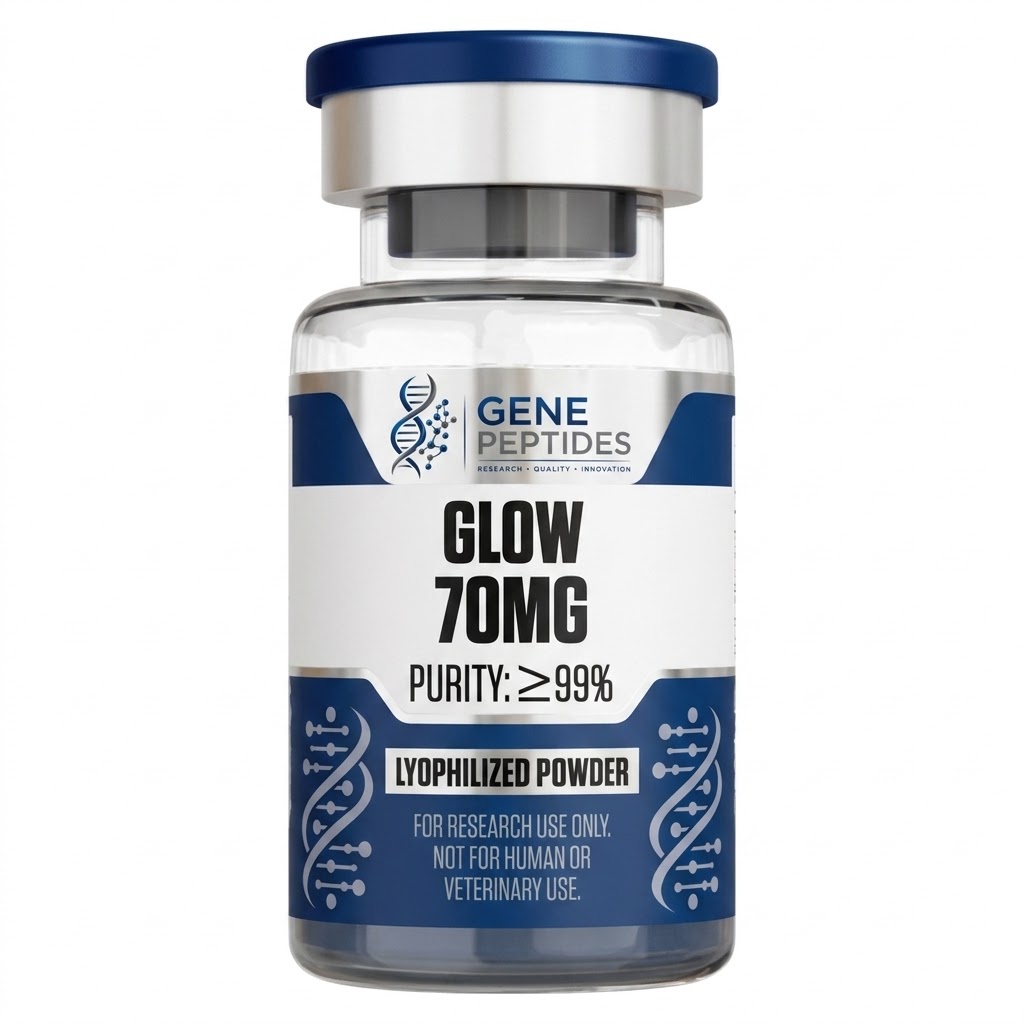
GLOW 70mg Blend is handled here as a peptide blend research material. The product name identifies a blended research-use-only material, so procurement review should focus on the documented component identity, analytical method, product form, lot number, and batch-specific COA rather than assumptions about the blend name. Blend composition should be evaluated through documentation and identity review, not expected outcomes or use protocols.
For peptide blends, the name alone is not a complete molecular definition. A laboratory buyer should review whether documentation identifies the relevant component names, molecular categories, analytical signatures, and batch-level quality data. Public chemical and protein databases can be useful for general identity context: PubChem is an NIH chemical information resource that aggregates compound, substance, and bioactivity data from many sources [5], UniProt provides curated and computational protein sequence information [6], and ChEMBL provides curated bioactivity and chemical biology data [7]. These resources support literature orientation; they do not replace batch-specific supplier documentation.
Peptide identity and purity are commonly evaluated with chromatographic and mass-based methods. HPLC has long been used for peptide separation, purification, and characterization, including reversed-phase, ion-exchange, and size-exclusion approaches [8]. Reversed-phase liquid chromatography remains a central method for peptide separation in analytical workflows [9]. Mass spectrometry is also widely used in peptide and protein analysis because it can provide mass and sequence-related information relevant to identity review [10].
Why Researchers Search “Buy GLOW Online”
Researchers search “buy GLOW online” to evaluate whether a supplier offers a documented GLOW research-use-only material with transparent product records. The practical intent is not to obtain use guidance. It is to compare RUO product availability, identity documentation, purity data, COA access, lot number matching, label consistency, storage information, product form, and supplier language.
A technical buyer who needs to buy GLOW for a controlled laboratory workflow should confirm that commercial language stays within research procurement boundaries. That means the supplier should not substitute promotional claims for analytical documentation. The GLOW supplier documentation should let a reviewer connect product name, lot number, COA, purity result, identity testing, product form, and storage guidance in one consistent record.
Research Procurement Checklist for GLOW
- Verify that GLOW is labeled for research use only.
- Review the available batch-specific GLOW COA before procurement.
- Confirm that the COA includes purity documentation and identity information.
- Check whether HPLC, LC-MS, mass spectrometry, or an equivalent analytical method is listed.
- Compare the product name, amount, lot number, and documentation for consistency.
- Assess whether the supplier avoids dosage, administration-route, therapeutic, diagnostic, or human-use claims.
- Document storage and handling information in laboratory records.
- Evaluate whether the lyophilized powder form matches the intended research workflow.
- Confirm that the product is not marketed for human or animal consumption.
- Record GLOW identity testing, GLOW purity documentation, and GLOW supplier documentation before internal approval.
GLOW Quality Signals to Review Before Buying Online
Researchers searching to buy GLOW online for laboratory research should review quality signals before selecting any RUO supplier. Analytical validation guidance such as ICH Q2(R2) describes principles for validating analytical procedures, while ICH Q14 discusses science-based analytical procedure development [11] [12]. These sources are not product approvals; they provide useful context for how laboratories think about analytical reliability.
| Evaluation Area | What Researchers Should Review | Why It Matters for RUO Procurement |
| RUO labeling | Confirm the product is clearly labeled for research use only | Helps separate research procurement from human-use positioning |
| COA availability | Review the available batch-specific certificate of analysis | Supports lot-level documentation and quality review |
| Purity data | Look for analytical support for the stated purity | Helps evaluate material consistency |
| Identity testing | Review HPLC, LC-MS, mass spectrometry, or related identity data | Helps confirm the material matches the listed compound or blend |
| Lot traceability | Match lot numbers across product and documentation | Supports research recordkeeping |
| Product form | Confirm whether the material is supplied as lyophilized powder or another documented form | Supports laboratory planning |
| Storage information | Review storage and handling documentation | Helps maintain material integrity in laboratory settings |
| Supplier language | Confirm the supplier avoids dosage, therapeutic, diagnostic, or personal-use claims | Supports research-use-only positioning |
COA, Purity, and Identity Documentation
COA review is the center of RUO procurement. For GLOW 70mg Blend, researchers should review the compound or blend name, product amount, lot number, test date, purity percentage, testing method, identity confirmation, product form, and storage documentation. A purity percentage alone does not establish complete compound identity; researchers should evaluate purity, identity, method, lot number, and documentation together.
NIST describes Standard Reference Materials as materials with well-characterized composition or properties, illustrating the documentation principle behind reference quality and measurement confidence [13]. NIST FAQ language also notes that lot or serial numbers can appear on a COA and should match the corresponding material identifier for quality purposes [14]. For an RUO peptide blend, the same recordkeeping logic is important: the GLOW COA should connect to the received lot.
For peptide materials, HPLC can support purity review, while LC-MS or mass spectrometry can support identity and mass-related confirmation [8] [10]. LC-MS peptide mapping is widely used for sequence and identity-related characterization in protein and peptide workflows [15], and published work on LC-MS peptide mapping validation illustrates the importance of method suitability when mass spectrometric detection is used for identity-related testing [16].
Reviews
There are no reviews yet.